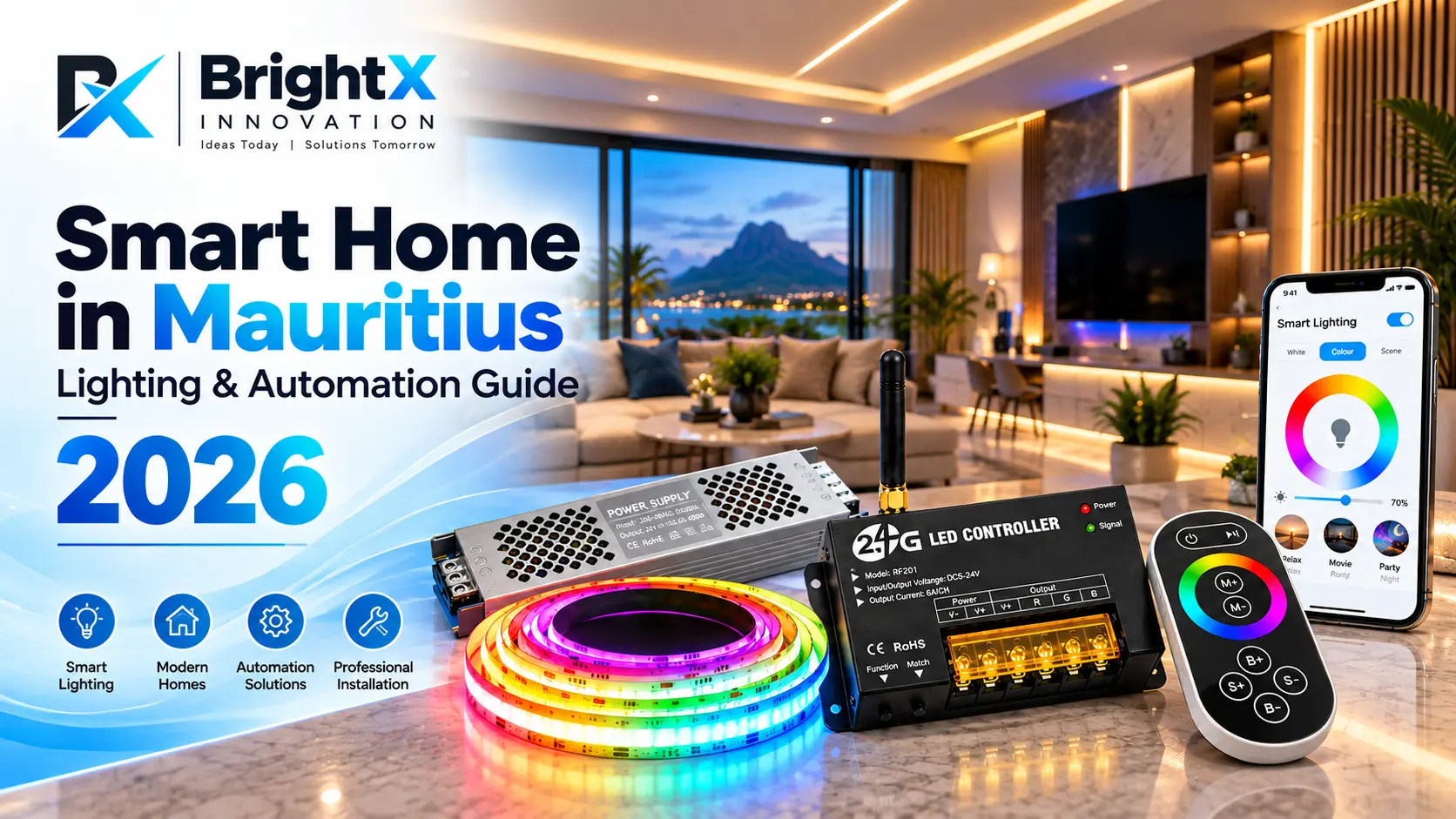
A smart home does not have to mean replacing every switch or installing an entirely new electrical system. For many homes in Mauritius, the most practical starting point is lighting: deciding which lights should be controlled together, how people will operate them, and whether dimming or colour adjustment would make the space more comfortable.
Smart home lighting connects compatible lights with switches, controllers, remotes or automation devices so selected areas can be managed more conveniently. The right arrangement depends on the lighting already installed, the electrical layout and the functions you actually want to use.
BrightX Innovation offers lighting product selection, smart home integration and professional installation support. Its listed products include an RGB controller with remote and compatible LED lighting components, making it possible to discuss both the lighting and how it will be controlled as part of one project.
What makes a lighting setup part of a smart home?
Traditional lighting typically turns a circuit on or off from a wall switch. A connected lighting setup can add functions such as remote operation, adjustable light levels, grouped zones or preset scenes, provided the selected equipment supports them. For example, a living room may use separate lighting circuits for general lighting and concealed LED accents, so each can be operated to suit different activities.
A smart switch, LED dimmer and RGB controller are not interchangeable. A switch usually manages power to a circuit. A dimmer changes brightness when the light source and driver are compatible. An RGB controller changes the output of a compatible colour-changing LED product. Some devices combine functions, but their features must be confirmed before purchase.
Smart lighting components: what each one does
| Component | Its purpose | Check before choosing |
|---|---|---|
| Smart wall switch | On/off or other supported control of a lighting circuit | Wiring, load, neutral requirement, communication method |
| LED dimmer | Adjusts brightness on a compatible lighting circuit | Driver and lamp dimming compatibility; load limits |
| RGB LED controller | Controls colour effects or modes on compatible RGB LED strips | Strip voltage, channels, current rating and supported functions |
| Remote or app control | Provides an alternative way to operate supported equipment | Supported connection and whether a hub or network is required |
| LED driver or power supply | Provides the power required by a compatible LED system | Input/output ratings, total load and installation conditions |
Confirm compatibility at the product level. A standard fixed-output driver does not necessarily support dimming, and an RGB remote does not automatically make a system Wi-Fi enabled. If you are upgrading an existing home, an assessment of the present wiring is especially useful before selecting switches or controllers.
For colour-changing lighting, BrightX lists an RGB controller with remote and compatible power supplies. Check the exact strip and controller ratings before selecting these components.
Where smart lighting is useful in Mauritius homes
Living rooms and open-plan areas
Separate lighting zones can help a room work for different activities. General lighting may be needed for cleaning or family gatherings, while concealed LED lighting creates a quieter atmosphere in the evening. If scene control is part of the chosen system, compatible zones can be grouped for simpler operation.
Bedrooms and villa interiors
Bedside switching and controllable accent lighting can reduce the need to operate several fittings individually. Warm-white concealed lighting may suit relaxed spaces; colour-changing effects are better treated as an optional decorative layer rather than the only lighting in a bedroom.
Kitchens, offices and hospitality spaces
Practical lighting matters more than decorative effects in work areas. Kitchen worktops need clear task lighting, and offices need consistent illumination. Restaurants and guest areas may benefit from separately controlled lighting zones, with dimming specified only where supported by the light sources and drivers.
The best system is one that people can operate easily every day. More features are not automatically better if they complicate maintenance, replacement or use by guests and other household members.
Planning a smart home lighting system
Start by listing the rooms and deciding what needs to be controlled. A plan for two lighting zones in a living room will be quite different from a whole-villa layout. Decide whether you need simple on/off switching, brightness adjustment, RGB colour control, or a combination of those functions.
Before buying equipment, review these practical points:
- Existing wiring: identify circuit arrangements and whether the proposed controls need additional conductors or a neutral wire.
- Lighting compatibility: match the switch, dimmer or controller to the actual LED strip, fixture and driver.
- Voltage and load: verify ratings and allow for the installation conditions specified by the equipment manufacturer.
- Connectivity: establish whether operation relies on a remote, local hub, wireless network or another supported system.
- Manual operation: consider what users should be able to do when a phone is unavailable or connectivity is interrupted.
- Future maintenance: keep product information, cable access and replacement compatibility in mind.
A qualified electrical professional should assess new wiring, circuit alterations and mains connections. This is particularly important during renovations where existing wiring may differ from the proposed control layout.
Smart home installation: new builds versus renovations
For a new home, planning control locations during the electrical stage can make routing, access and the finishing work simpler. The lighting designer, electrician and interior contractor can agree on the number of circuits, positions of controllers and where LED power supplies will remain accessible.
For a completed property, the first step is checking what is already installed. Some control upgrades can work with existing wiring, while others require changes to switches, drivers or circuit arrangements. Product selection should follow that assessment, not precede it.
BrightX's smart home integration and professional installation services can support coordination of compatible lighting controls with the wider lighting layout. The scope and equipment should be agreed for the individual project.
Discuss your rooms, lighting zones and existing electrical layout with BrightX before selecting the controls and installation approach.
Explore Smart Home Integration →Choosing between smart switches, dimmers and colour controls
If your goal is simply to turn a light on and off from a different control point, a suitable switch arrangement may be enough. If you want lower light levels for evening use, the light source and driver must be dimmable and work with the selected dimming method. For decorative colour effects, an RGB LED strip needs an appropriate RGB controller and power arrangement.
The selected RGB LED strip type also affects the colour effect and power requirements. BrightX lists a 24 V RGB COB strip and a controller with remote, but remote colour control alone does not establish app connectivity or whole-home automation. Confirm the supported functions and model compatibility.
Buyers should ask for a complete compatible setup rather than ordering a switch, strip and power supply independently. That helps avoid mismatched electrical ratings, unsupported dimming or controls that do not deliver the intended result.
Smart home lighting solutions from BrightX Innovation
BrightX Innovation supports Mauritius residential and commercial lighting projects with product guidance, smart home integration, installation and project coordination. Its catalogue includes LED strips, RGB lighting controls, power supplies and concealed-lighting profiles. These can be selected around the intended lighting effect and available control features.
For an enquiry, share the property type, the rooms or zones involved, whether the project is new or a renovation, and the control functions you want. Photos, drawings or an existing lighting schedule can also help clarify the requirements. The team can then discuss suitable products and the relevant installation scope.
Looking for lighting controls or installation support in Mauritius? Send BrightX the project details to discuss suitable products and the next steps.
Request a Lighting Consultation →Frequently asked questions about smart home lighting
Can I add smart lighting to an existing house?
Often, yes, but it depends on the current wiring and the lights being controlled. Some upgrades use compatible replacement controls; other setups require changes to drivers or circuits. Have the existing installation assessed first.
Does a smart switch work with every LED light?
No. Switches and dimmers must be matched to the electrical load and the lighting equipment. In particular, an LED dimmer needs compatible dimmable lights and drivers.
Do smart lights always need Wi-Fi?
No. Depending on the product, lighting may use local remote control, a wired controller or a connected system. The control method must be checked against the specific equipment selected.
What is the difference between smart home automation and RGB lighting control?
RGB control changes supported LED colours or effects. Home automation can coordinate several compatible devices or functions through a broader control system. An RGB controller alone should not be assumed to provide whole-home automation.
Can smart lighting be installed during a renovation?
Yes, subject to wiring, accessibility and equipment compatibility. Planning early helps identify where control devices and power supplies can be safely located and maintained.
For a home with controllable lighting, decide which rooms need separate zones, which functions should work without an app and how power supplies and controllers will remain accessible. Those decisions help define the equipment and installation scope.